CF Industries’ approach to energy management, emissions reduction, and climate resilience is grounded in operational excellence, disciplined capital investment, and strategic partnerships. In 2025, these efforts continued to support the Company’s leadership position in advancing the energy transition while strengthening the resilience and efficiency of our global manufacturing network. CF Industries’ initiatives are designed to deliver measurable progress towards our long-term decarbonization goals while enabling the production of low-carbon ammonia for agricultural, industrial, and clean energy applications.
Environmental Goals
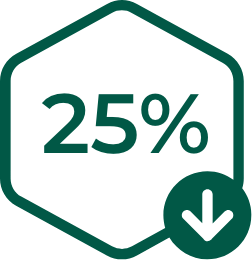
CO2-equivalent emissions reduction per ton of product by 2030 (2015 baseline year)

of Scope 3 emissions will be reduced by 2030 from 2020 baseline

Achieve Scope 1 and Scope 2 net-zero greenhouse gas emissions by 2050
Develop, implement, and maintain an integrated nature strategy based on the Company's material issues, including with respect to nutrient & water stewardship, soil health, and biodiversity.
Our Decarbonization Approach
CF Industries’ decarbonization strategy spans the full ammonia production value chain and focuses on both direct emissions reductions within the Company facilities and collaboration with third parties to address emissions not within our direct control. Further, our use of natural gas feedstock results in GHG emissions approximately 50% lower than coal-based ammonia production. Continuous efficiency and reliability improvements further reduce natural gas consumption per ton of product, reinforcing our lower-carbon positioning while supporting operational uptime and cost discipline.
This past year, CF Industries advanced several transformational clean energy initiatives:
- In April 2025, we unveiled a joint venture with JERA Co., Inc., Japan’s largest energy company, and Mitsui & Co., Ltd., a leading global investment and trading company, to build the world’s largest low-carbon ammonia plant that will supply low-carbon ammonia globally.
- In July 2025, we commenced operation of our carbon capture and sequestration (CCS) initiative at our Donaldsonville Complex in Louisiana, for which we have partnered with ExxonMobil for the transportation and permanent storage of up to 2 million metric tons of CO₂ annually that would have otherwise been emitted into the atmosphere, with our Donaldsonville project earning 45Q tax credits.
- In September and October 2025, we completed our first sales of low-carbon ammonia to customers in Africa and Europe, which were certified low-carbon under the Verified Ammonia Carbon Intensity Program. The sale prices were at a premium to conventional ammonia prices.
- In October 2025, we installed N₂O abatement at one of our Verdigris Nitric Acid facilities, which is expected to reduce N₂O emissions by over 600,000 tons CO₂-e.

Reducing Our Operational Emissions
Our approach to addressing Scope 1 emissions continues through four strategic pathways: operational efficiency enhancements, advancement of CCS technologies, expanded nitrous oxide abatement programs, and investment in next-generation ammonia production technologies.
Operational efficiency remains the foundation of CF Industries’ decarbonization strategy. Process optimization, improved capacity utilization, and capital investments reduce emissions intensity while maximizing production reliability and output.
CCS remains a cornerstone of CF Industries’ Scope 1 emissions-reduction pathway. Process CO₂ from natural gas feedstock in ammonia production represents approximately 60–70% of total emissions. In 2025, we commenced carbon capture and sequestration at our Donaldsonville Complex in Louisiana. CF Industries is developing a similar CCS project at our Yazoo City facility and is evaluating additional CCS projects at our Medicine Hat and Waggaman Complexes.

Climate Risk and Resilience
In 2025, CF Industries engaged a third-party to conduct two related climate risk analyses, covering transitional and physical climate risks to our business. The physical risk assessment examined potential operational impacts of chronic and acute climate hazards such as floods, storms, drought, and extreme heat across multiple climate scenarios. The transitional assessment reviewed both risks and opportunities related to the transition to a low-carbon economy under multiple climate scenarios, including impacts related to regulatory and market changes.
These assessments validated that decarbonization is one of the most critical sustainability topics for our business and our industry, presenting both significant risks and opportunities. Our efforts to mitigate climate risks and capitalize on decarbonization opportunities are described in detail throughout this Report.
Building on these assessment results, CF Industries has continued to enhance the resilience of our manufacturing and distribution sites. Each location maintains and updates a comprehensive weatherization plan that includes safety measures, preparation and maintenance activities, instrumentation upgrades, operational improvements, and utility improvements undertaken with our utility suppliers.

Industry Emissions Reduction Projects
Energy-intensive industries seeking to proactively manage their carbon footprints have identified ammonia as a promising clean energy source. Ammonia provides greater hydrogen density than compressed gaseous or liquid hydrogen, and this density-related advantage, along with existing global production and infrastructure, positions ammonia as a preferred hydrogen transport medium. Ammonia as a low-carbon maritime fuel continues to be the leading fuel candidate to achieve net-zero goals for shipping, and interest in co-combustion with ammonia for power generation is increasing, primarily in Japan and South Korea.
Scope 1, 2 and 3 Reduction Initiatives

CF Industries’ Scope 1 emissions are generated primarily from our use of natural gas a feedstock and fuel during the production of ammonia and nitric acid.
Current and future initiatives
Allocate capital investments for facility upgrades to improve efficiency.
Continue developing and expanding our CCS capabilities.
Expand N2O emissions abatement efforts across our facilities.
Identify and evaluate alternative ammonia production technologies with lower carbon intensities.

CF Industries’ Scope 2 emissions are GHG emissions associated with the purchase of electricity to power our facilities and corporate offices.
Current and future initiatives
Diversify our purchased-electricity portfolio mix with a variety of renewable energy procurement strategies.

CF Industries’ Scope 3 emissions account for the indirect emissions associated with our upstream and downstream supply chain, including the use of our products
Current and future initiatives
Purchase MiQ-certified natural gas for ammonia production.
Partner with industry peers and third-party organizations to expand collaborative efforts.
Participate in agricultural associations to promote best practices in the value chain.
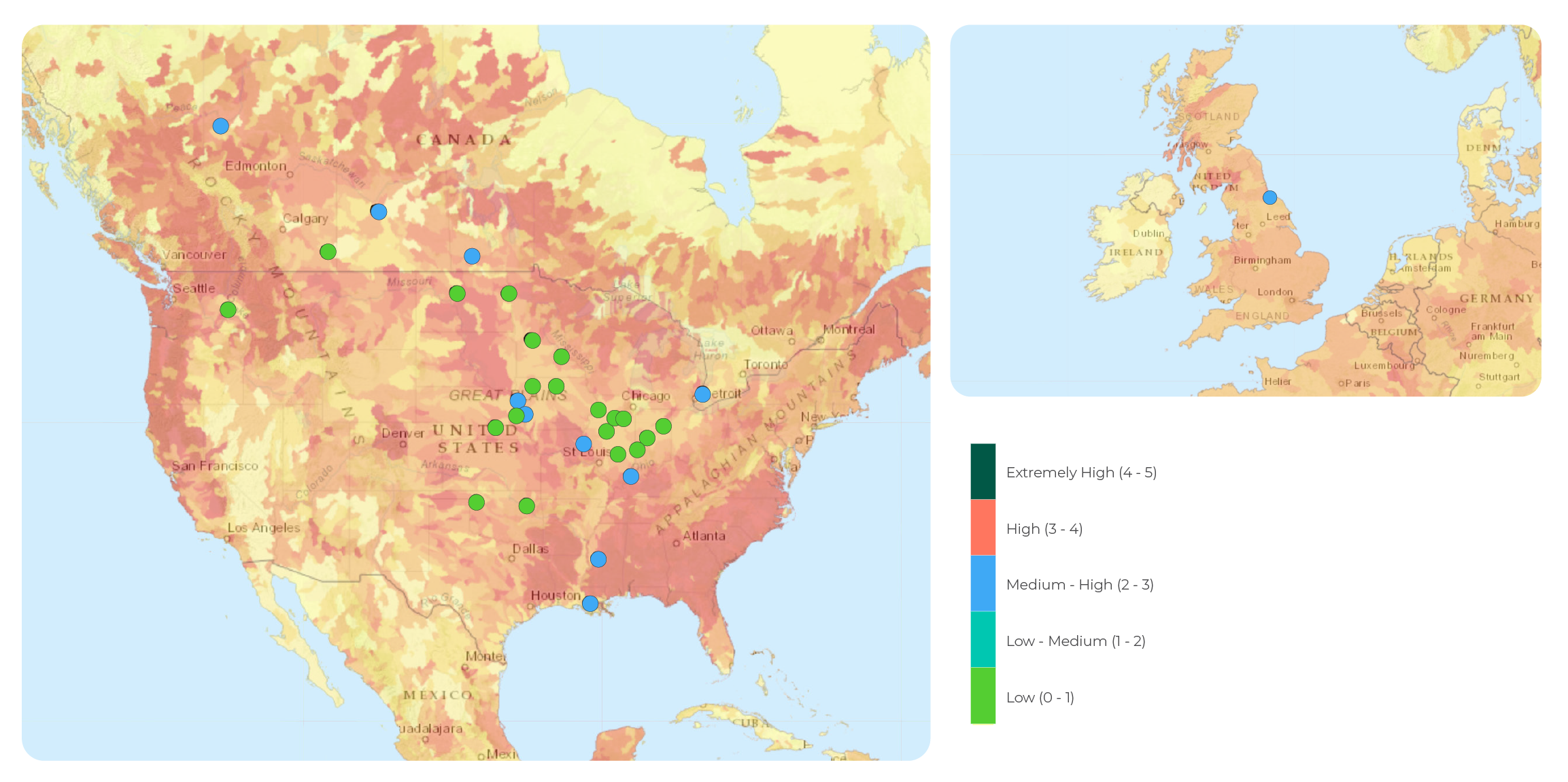
CF Industries conducts a biodiversity impact assessment through the World Wildlife Fund Biodiversity Risk Tool, annually, and is committed to managing our impact on nature and the ecosystems in which we operate within and near.
Environmental Stewardship
As a company whose operations and products rely on natural resources, CF Industries is intentional in its product design, capital developments, and operations to protect biodiversity. We are committed to maintaining – and in some cases exceeding – compliance with regulations that protect our environment, including air, water, and waste regulations. Our drive for continuous improvement has motivated our environmental stewardship through our sustainability goals and initiatives.
Case Study
ExxonMobil Carbon Capture and Sequestration Partnership
In July 2025, we commenced operation of our carbon capture and sequestration (CCS) initiative at our Donaldsonville Complex in Louisiana, for which we have partnered with ExxonMobil for the transportation and permanent storage of up to 2 million metric tons of CO2 annually that would have otherwise been emitted into the atmosphere.
READ MORE