
Key Questions About Fertilizer and Its Price Answered
By: Corporate Communications
March 27, 2026
Company
Share
CF Industries is a global leader in safe, industrial-scale production of ammonia and other nitrogen products, which today are primarily used as fertilizer. With six nitrogen complexes in the United States two in Canada and one in the United Kingdom, we have an average annual capacity of nearly 10.5 million tons on a gross ammonia basis.
Nitrogen fertilizers are globally traded commodities, much like the energy inputs required to produce them and the crops they feed. They are manufactured by more than 100 producers in 60 countries and traded around the world. According to the International Fertilizer Association, approximately 200 million tons of ammonia are produced and consumed annually.
While most people have a basic understanding of what fertilizer is and its important role in growing the food needed to feed the world, there are many questions about how it is produced and sold to farmers. The following answers a number of questions we’ve been hearing lately.
1. How are nitrogen fertilizers made?
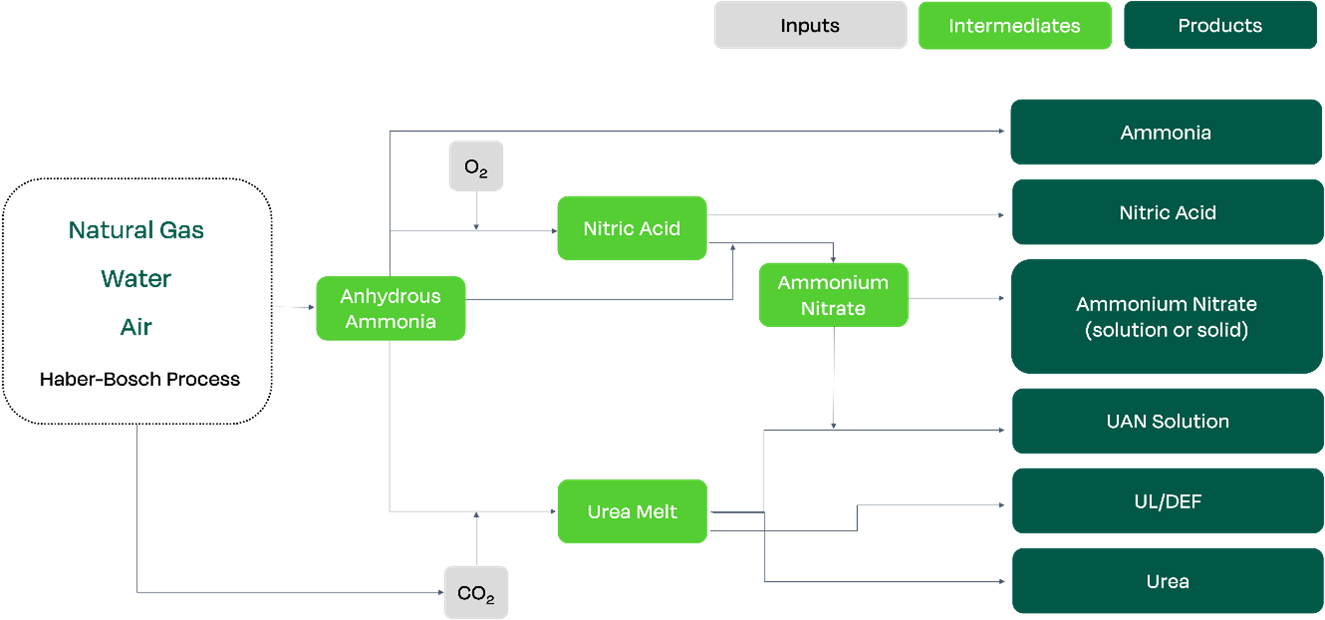
Fertilizer production relies on the Haber-Bosch process. First, ammonia is produced by synthesizing hydrogen from a fossil fuel feedstock (all of CF Industries’ facilities use natural gas) with nitrogen from the air. Once produced, ammonia is primarily used for its nitrogen content as a fertilizer itself or as the basis of upgraded nitrogen fertilizers such as granular urea, urea ammonium nitrate solution (UAN) and ammonium nitrate (AN).
2. How much does it cost to produce nitrogen fertilizers?
The cost of producing nitrogen fertilizers is highly dependent on the cost and availability of natural gas, which is the principal raw material and primary fuel source used in the ammonia production process at our manufacturing facilities. For many producers globally, more than 70% of the variable cost to produce ammonia is from the cost of natural gas.
Nitrogen is a globally traded commodity. The market for nitrogen fertilizers is affected by global supply and demand factors, as well as domestic or local conditions. Intense global competition – including import volumes and prices – strongly influences delivered prices for nitrogen fertilizers around the world.
Nitrogen fertilizer production is also a capital-intensive industry, requiring ongoing investments to maintain and operate existing production safely and reliably, let alone expand production capacity.
- At CF Industries, we annually spend approximately $500 million dollars on capital improvements to our existing production network to maintain production reliability and supply of nitrogen fertilizer products.
- From 2012–2016 CF Industries invested more than $5 billion at our Iowa and Louisiana facilities to increase our total production capacity by 25%.
- We are also currently working on a $3.7 billion project announced last year to build the largest new ammonia plant in the world by nameplate capacity here in the United States in partnership with our Japanese partners (JERA and Mitsui).
Our facilities also employ thousands of skilled American manufacturing workers and provide strong support to local communities, largely located in rural America.
3. How does the Iranian conflict affect the price of nitrogen fertilizer in the United States?
U.S. prevailing prices for nitrogen fertilizers are a reflection of current global market realities driven by supply and demand dynamics. In recent weeks, this has led to price fluctuations as supply and trade disruptions in the Middle East continue to unfold.
- The Middle East is one of the world’s largest nitrogen producing and exporting regions due to its low-cost natural gas supply.
- Nitrogen production in the Middle East accounts for approximately 30% of globally traded ammonia and approximately 35% of globally traded urea, the most widely used nitrogen fertilizer globally.
- Safety concerns amid ongoing attacks by Iran and unavailability of war risk coverage on affected vessels brought the flow of vessels through the Strait of Hormuz to a halt, which has prevented the export of nitrogen fertilizers.
- Additionally, liquefied natural gas (LNG) supply out of the Middle East has been restricted, affecting nitrogen producers reliant on imported LNG, such as Europe, India, Pakistan, and Bangladesh. Facilities in these areas are either temporarily shut down or operating at reduced rates, further constraining global supply.
This supply shock to the global nitrogen market has predictably resulted in higher prices globally. However, the price of nitrogen fertilizer in the United States is significantly lower than global prices.
4. With prices so high, why don’t nitrogen fertilizer manufacturers in the United States increase production?
Nitrogen fertilizer manufacturers in the United States typically run their facilities 24 hours a day, seven days a week for as long as they safely can unless there is planned or unplanned maintenance needed or other disruptions occur.
CF Industries does not have latent capacity. In 2025, we operated our facilities at a 97% gross ammonia utilization rate. Over the last five years, it has averaged 96%—10% higher than our North American peers. This means that, compared to North American peers, we produce approximately one million tons of ammonia more per year. Those tons serve American farmers as ammonia or as ammonia-derived products such as granular urea and UAN.
Additionally, the ability to respond to high demand with new supply quickly is limited as it takes at least 3-4 years to build new nitrogen fertilizer capacity. We expect to begin construction this year on a new ammonia plant in Louisiana, with start-up expected in 2029.
5. Is there anything CF Industries can do to increase the supply of fertilizer in the near-term?
Since the conflict in Iran began, we have taken the following actions to increase supply of fertilizer into the United States:
- We have delayed a multi-week repair and maintenance turnaround event at our largest ammonia plant at our Donaldsonville, Louisiana, Complex, the world’s largest ammonia production complex. As a result, we expect to be able to supply approximately 100,000 additional tons of granular urea to U.S. customers that would not otherwise have been available for this spring application season. Planning for this turnaround event began more than three years ago, and conducting it involves hundreds of highly skilled construction personnel working around the clock. Turnaround events are critical to maintaining both our high plant-on-stream factor and our excellent safety record. While the turnaround cannot be delayed indefinitely, we decided to take this significant step to help mitigate shortages caused by the closure of the Strait of Hormuz.
- We have prioritized new sales to our U.S. customers that supply U.S. farmers. Specifically, we are currently foregoing new higher-priced export orders during this spring planting season to keep more nitrogen fertilizer product available to U.S. farmers.
- We are converting 100 ammonium nitrate hopper railcars to granular urea service that would otherwise not be used this spring, expanding our capacity to ship granular urea throughout the United States. Over 90 railcars have already been converted with the remainder scheduled to be converted by the end of March.
- We are reviewing all of our operations and distribution channels to maximize our ability to produce and distribute the most nitrogen fertilizer products as we possibly can.
6. What else can be done to address the supply of fertilizer in the United States?
We support solutions that increase the availability of nitrogen fertilizer to American farmers. The Trump Administration’s decision to allow more Venezuelan fertilizer to be imported into the United States, deploy maritime reinsurance for vessels carrying fertilizer in the Middle East, and expand domestic transportation options for fertilizer and other commodities are important steps. We also believe that there are additional initiatives proposed by The Fertilizer Institute that could provide near-term relief and limit further challenges, including:
- Maintaining continued seamless trade with Canada, which supplies an important portion of U.S. nitrogen fertilizers;
- Temporarily supporting movement of LNG exports to Europe, India, Pakistan, Egypt and Bangladesh from other destinations to limit shutdowns of foreign nitrogen plants due to gas prices; and
- Providing temporary regulatory flexibility where legally permissible to facilitate U.S. production and transportation of fertilizer, including hours of service exemptions and prioritization of fertilizer shipments on railways and barges during peak weeks.